ACL Reconstruction in Savoie – Dr Victor Pacoret, Orthopaedic Surgeon
Understanding an anterior cruciate ligament (ACL) tear, deciding whether surgery is needed, choosing the right graft for your sport and preparing your return to activity — especially skiing and mountain sports. Médipôle de Savoie, near Chambéry.
An anterior cruciate ligament (ACL) tear is one of the most common knee injuries in skiing and pivoting sports. Surgery is not automatic: it is recommended for young or active people who practise pivoting sports and for knees that give way. When needed, the ligament is reconstructed by keyhole surgery (arthroscopy) with a tendon graft, usually as day surgery, about 4 to 8 weeks after the injury. Rehabilitation lasts 6 to 9 months; skiing usually resumes at 6 to 8 months, and pivoting or contact sports at around 8 to 9 months after objective tests.
Written and medically reviewed by Dr Victor Pacoret, orthopaedic surgeon · Last updated:
What is the ACL and how does it tear?
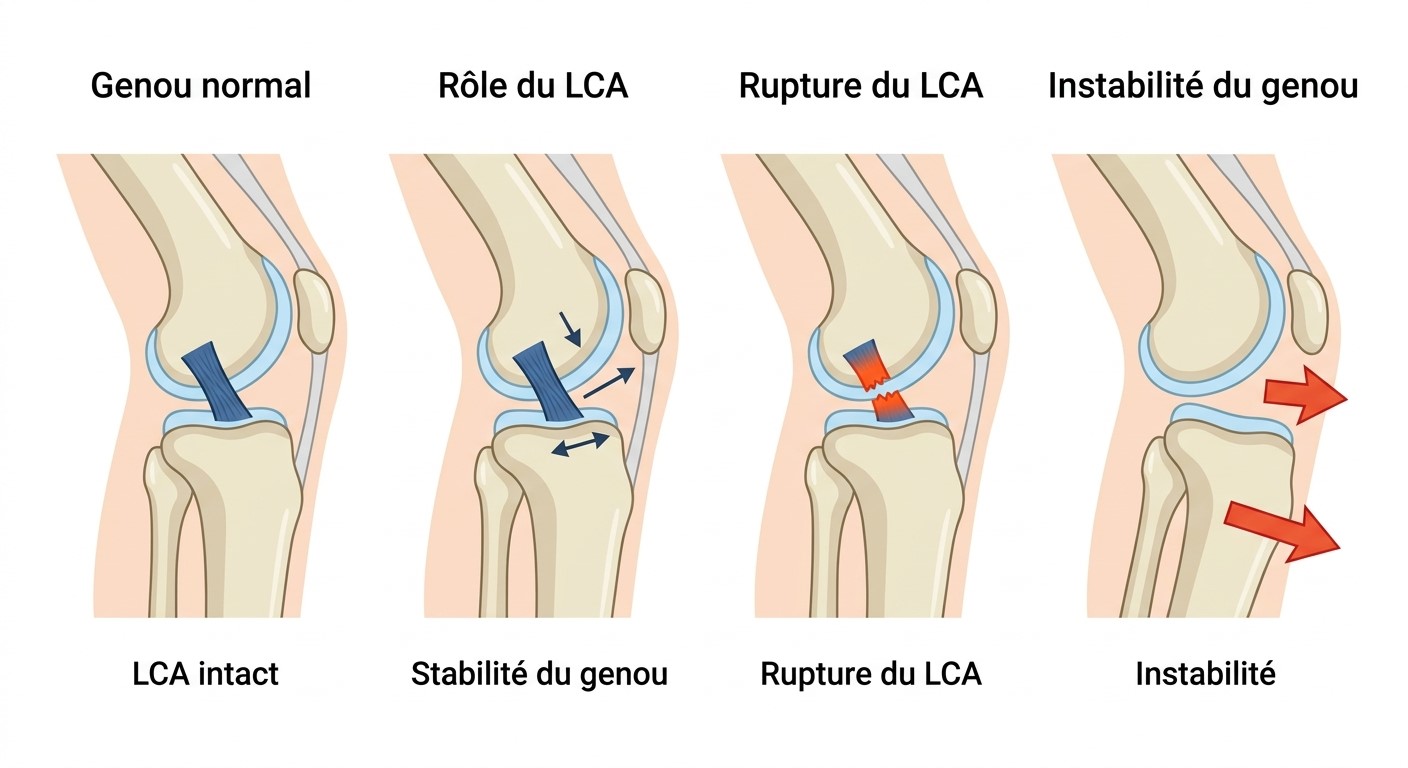
The anterior cruciate ligament (ACL) is one of the four main ligaments of the knee. It runs inside the joint, from the femur (thigh bone) to the tibia (shin bone), crossing the posterior cruciate ligament — hence its name. It locks the tibia under the femur and prevents excessive rotation when you change direction.
Without a working ACL, the knee can “give way” when pivoting, landing from a jump or skiing downhill. If this instability is left untreated, it can lead over time to meniscal and then cartilage damage that cannot be reversed.
From a stable knee to instability: the role of the ACL (diagram labels in French).
Key figures
In France, more than 50,000 ACL tears occur each year, about 42,000 of which are operated on (French hospital data, 2019). In the Alps, skiing is the leading cause, ahead of pivoting and contact sports. For the same sport and level, women have a 2 to 3 times higher risk.
How does it happen?
Twisting on a planted foot: sudden change of direction (football, handball, basketball)
Unbalanced landing from a jump, with the knee collapsing inwards
Skiing fall: typically a backward fall with the outer ski twisting the knee (“phantom foot” mechanism)
Hyperextension or a direct blow (tackle)
What are the symptoms?
An ACL tear is often a sudden, easily identified event, but it can also go unnoticed at the time. These signs should alert you:
Immediately
A pop
A popping sensation or sound at the moment of injury, sometimes heard by others. Very suggestive of a ligament tear.
Within hours
Rapid swelling
Bleeding into the joint (haemarthrosis) within 1 to 3 hours: the knee becomes tight, painful and warm. Almost always present with a complete tear.
In the following days
Limping
Difficulty putting weight on the leg; bending is limited by pain and swelling. Walking is possible but cautious.
Later on
Giving way
“My knee lets me down” when changing direction, going downstairs or landing. A sign of chronic instability — a clear reason to consider surgery in an active person.
Beware of “silent” tears
In less active people, a tear can go unnoticed: the knee regains its movement, the swelling settles and normal life resumes — until the knee gives way during a pivoting movement. An MRI is recommended after any sudden swelling of the knee following an injury.
How is an ACL tear diagnosed?
The diagnosis relies on three complementary elements: how the injury happened (mechanism, pop, swelling), a specific clinical examination and imaging.
Lachman test
The most sensitive test. With the knee slightly bent, the surgeon gently pulls the tibia forwards: excessive movement with a soft end-point indicates a tear.
Pivot-shift test
The most specific test. It reproduces the rotational instability typical of an ACL tear.
Anterior drawer test
With the knee bent at 90°, the surgeon checks for abnormal forward movement of the tibia. Useful as a complement.
Associated injuries
Meniscal tests and checks of the other ligaments. An isolated ACL tear is uncommon, and a complete assessment guides the decision.
MRI: the key examination
MRI of the knee confirms the tear with a sensitivity above 95% and, above all, shows:
a meniscal tear, present in 50 to 70% of cases, which may change the surgical plan
cartilage damage or bone bruising
the condition of the other ligaments
Already had an MRI?
Bring the images (CD, USB stick or online access link) and the radiologist’s report to your consultation. This allows us to discuss the surgical strategy straight away.
Do I need surgery?
Not always. The decision is shared between you and your surgeon, based on four main factors: age, type and level of sport, how unstable the knee feels, and associated injuries.
Surgery recommended
Young, pivoting or contact sports
Football, alpine skiing, rugby, handball, basketball, judo. Reconstruction protects the menisci and allows you to keep your level of sport.
Surgery recommended
Knee giving way
Repeated episodes of giving way in daily life or at work, with a high risk of further damage.
Discussed case by case
Moderate activity, straight-line sports
Cycling, straight-line running, swimming put less strain on the ACL. The decision depends on how you feel and on your goals.
Rehabilitation alone
Less active, stable knee
If the knee is stable in daily life, strengthening physiotherapy and adapted activities may be enough, with regular check-ups.
Meniscal tears: a key factor
An unstable meniscal tear in a repairable area leads us to operate sooner, so that the meniscus can be repaired during the same operation. The meniscus protects the cartilage: saving the meniscus protects the knee in the long term.
How is the operation performed?
ACL reconstruction replaces the torn ligament with a graft taken from your own tendons (autograft). The torn ACL is not “repaired”: a new ligament is reconstructed in the anatomical position.
1
Anaesthesia
Regional or general
Spinal anaesthesia or a nerve block is preferred to limit pain after surgery. A nerve catheter may be left in place for 24 to 48 hours.
2
Graft
Harvesting the graft
Through a small incision, depending on the graft chosen (see below). This takes 10 to 15 minutes.
3
Arthroscopy
Exploring the joint
A camera is inserted through two small incisions. The ACL, menisci and cartilage are assessed and any other injury is treated (meniscal repair or trimming, cartilage treatment).
4
Bone tunnels
Anatomical drilling
Two tunnels (tibial and femoral) are drilled precisely at the original attachment points of the ACL. Accurate positioning is essential for stability.
5
Fixation
Passing and fixing the graft
The graft is passed through the tunnels and fixed with interference screws and/or cortical button devices.
6
Discharge
Home the same day
A hinged knee brace is fitted and crutches are provided. Physiotherapy starts on day 2.
Which graft is used?
No graft is better for everyone. The choice is made during the consultation, according to your sport, your anatomy, the degree of laxity and your history.
Two hamstring tendons (semitendinosus and gracilis) combined with a reconstruction of the anterolateral ligament on the outer side of the knee. Better control of rotational laxity and a significantly lower risk of re-rupture in published studies; quick return to walking, little pain at the front of the knee. Ideal for pivoting and contact sports, young patients and very lax knees.
Alternative
Rectus femoris tendon
Part of the quadriceps. A thick, strong graft with little anterior knee pain and a discreet scar, without using the hamstrings. Used when hamstring harvesting is not desirable.
Revision surgery
Patellar tendon, quadriceps tendon or rectus femoris
After a failed reconstruction or a re-rupture, the graft is chosen according to the remaining tendons, existing tunnels and your sport, after a full assessment of the cause of failure.
Special cases
Donor tendon (allograft)
Reserved for some complex revisions and for injuries involving several ligaments. Decided case by case; rarely used in France.
Our approach at the Médipôle
Dr Pacoret’s first choice is a hamstring graft combined with an anterolateral ligament (ALL) reconstruction, which clearly reduces the risk of re-rupture, particularly in young athletes, pivoting or contact sports and very lax knees. The rectus femoris is the main alternative. The choice is always made together during the consultation.
What is recovery like?
Rehabilitation is an integral part of the treatment: it turns a technically successful operation into a strong, functional knee. Expect 50 to 80 physiotherapy sessions over 6 to 9 months — 2 to 3 sessions a week at first, then about once a week after the third month. A physiotherapist experienced in sports injuries is strongly recommended.
Before surgery (“prehab”): regain full extension, reduce swelling, restore quadriceps control. A calm knee before surgery lowers the risk of stiffness afterwards.
Weeks 0–2: swelling control, range of motion (extension first), quadriceps activation, protected walking.
Week 2 to month 2: progressive bending (about 120° at 2 months), weaning off crutches then the brace, exercise bike, swimming pool.
Months 4–6: running with changes of direction, jumps, sport-specific movements.
Months 6–9: return to pivoting and contact sports after objective functional tests.
Pain after surgery is moderate and well controlled; it decreases quickly from the third day. Ice and keeping the leg raised help during the first week.
When can I return to sport and work?
Return to sport follows a precise timetable, validated by objective tests rather than by how the knee feels.
D+15
Phase 1
Walking without crutches
Full extension, bending to 90°. Gradual weaning off the brace.
W+6
Phase 2
Exercise bike
Progressive exercise bike, front-crawl swimming (not breaststroke), quadriceps strengthening.
M+3
Phase 3
Straight-line running
Progressive running on flat ground, specific strengthening, isokinetic strength tests.
M+5
Phase 4
Running with changes of direction
Advanced balance and agility work, controlled single-leg hops.
M+6
Phase 5
Back to skiing
Cross-country, then alpine skiing on easy slopes. Hiking and mountain biking.
M+8-9
Phase 6
Pivoting and contact sports
Football, rugby, handball, off-piste skiing after validated functional tests: strength symmetry (LSI) of at least 90%, symmetrical hop tests, approval by your physiotherapist and surgeon.
Do not go back too early
The 9-month milestone matters: in a cohort of athletes, each month that return to sport was delayed, up to 9 months after surgery, reduced the reinjury rate by about half [1]. The graft needs time to mature biologically. Patience and functional tests are the key.
Work
Office work: usually from 3 to 6 weeks working from home, then 6 to 8 weeks on site. Physical work (lifting, standing for long periods, building trades): usually 3 to 4 months off work.
Driving
Driving is usually possible after about 4 weeks, depending on the side operated.
Skiing after ACL surgery
In Savoie, ACL surgery is inseparable from skiing: it is the typical skier’s injury, and getting back on the slopes is often the main goal.
5 to 6 months: classic cross-country skiing on flat terrain, short sessions (30–45 min)
6 to 7 months: alpine skiing on green and blue runs, ski touring uphill, still wearing a protective brace
7 to 8 months: red runs, light fresh snow, snowboarding on gentle terrain
8 to 9 months: off-piste, freeride, racing — after functional tests
Timing surgery around the ski season
For skiers, the ideal time for surgery is April to June, allowing a return in time for the following season. Surgery in September–October usually means missing the current season but skiing fully the next year. This is discussed during the consultation.
What are the risks?
ACL reconstruction is a standardised operation, but like any surgery it carries risks that you should know before deciding. Most patients experience none of them.
Re-rupture of the graft (5–10%)
More frequent in young athletes (under 20) returning to pivoting or contact sports. Modern techniques, careful rehabilitation and a test-based return to sport reduce this risk.
Stiffness (< 5%)
Mainly loss of extension. Prevented by prehab and early, rigorous rehabilitation; if it persists, a manipulation under anaesthesia may be offered.
Infection (< 1%)
Rare but serious. Antibiotics are given during surgery. Any swelling with fever in the first 3 weeks requires urgent medical review.
Blood clot (< 1%)
Low but real risk, prevented by anticoagulant injections for 7 to 15 days depending on your profile, early mobilisation and compression stockings.
Pain at the front of the knee
More frequent after patellar tendon grafts than hamstring grafts. Usually temporary; kneeling may remain uncomfortable.
Complex regional pain syndrome
Very rare (< 1%): an excessive inflammatory and pain reaction, treated in a specialised pain centre.
Frequently asked questions
How do I know if my ACL is torn?
A twisting injury or awkward landing, a pop, rapid swelling of the knee within a few hours and a feeling that the knee gives way are very suggestive. The diagnosis is confirmed by clinical examination (Lachman and pivot-shift tests) and by MRI, which is more than 95% reliable.
Does every ACL tear need surgery?
No. The decision depends on your age, your sport and level, your work, how unstable the knee feels and any associated injury (meniscus, cartilage). Surgery is recommended for young people and for pivoting or contact sports (skiing, football, rugby, handball, basketball). If you are less active and the knee does not give way, rehabilitation alone may be enough.
How long after the injury is the operation done?
ACL surgery is rarely an emergency. The knee first needs to settle: full extension, little swelling and good quadriceps control. Surgery usually takes place 4 to 8 weeks after the injury. It may be brought forward if there is an unstable meniscal tear that can be repaired.
Is it day surgery?
Yes. An isolated ACL reconstruction is usually performed as day surgery (you go home the same day). An overnight stay is possible if another procedure is performed at the same time (for example a complex meniscal repair) or if you prefer.
When can I walk after the operation?
Full weight-bearing with crutches is allowed from the day after surgery, unless a meniscus has been repaired. Crutches are usually kept for 8 to 15 days, and the hinged knee brace for 3 to 6 weeks.
When can I ski again after ACL surgery?
Cross-country and alpine skiing on easy slopes are usually possible 6 to 8 months after surgery, once strength and functional tests have been passed. Off-piste skiing, freeride and racing come later, at around 8 to 9 months.
What is the success rate of ACL reconstruction?
Modern anatomical techniques restore a stable knee in more than 90% of cases. The risk of the new ligament tearing again is around 5 to 10% in adults; it is higher in young athletes under 20 who return to pivoting sports.
I injured my knee on a skiing holiday. Should I have surgery in Savoie or at home?
Both are possible. Because the operation is usually done several weeks after the injury, many visitors are diagnosed here and then treated at home. If you are operated on in Savoie, plan where you will do your 6 to 9 months of physiotherapy and how you will attend the follow-up visits. We can discuss the best option with you.
Sources
Grindem H, Snyder-Mackler L, Moksnes H, Engebretsen L, Risberg MA. Simple decision rules can reduce reinjury risk by 84% after ACL reconstruction: the Delaware-Oslo ACL cohort study. Br J Sports Med 2016;50(13):804-808. doi:10.1136/bjsports-2016-096031
Sonnery-Cottet B, Saithna A, Cavalier M, et al. Anterolateral ligament reconstruction is associated with significantly reduced ACL graft rupture rates at a minimum follow-up of 2 years: a prospective comparative study of 502 patients from the SANTI Study Group. Am J Sports Med 2017;45(7):1547-1557. doi:10.1177/0363546516686057
Other figures on this page reflect the information given on our French page and Dr Pacoret's practice at the Médipôle de Savoie.
Do you think you have torn your ACL?
A specialist consultation gives you a precise diagnosis and a strategy adapted to your sport and your plans. Appointments with Dr Pacoret can be booked online on Doctolib (available in English), 24 hours a day.
This page does not replace a medical consultation. In an emergency, call 112 (European emergency number) or 15 (French emergency medical service, SAMU), or go to the emergency department of the Médipôle de Savoie (+33 (0)4 79 26 82 82).