Total Hip Replacement in Savoie – Dr Victor Pacoret, Orthopaedic Surgeon
A total hip replacement is one of the most effective operations in modern medicine. With the minimally invasive anterior approach and enhanced recovery, recovery is quick, dislocation is rare and most activities resume within a few weeks.
A total hip replacement replaces the worn hip joint with an artificial cup, stem and head. It is considered for advanced osteoarthritis, avascular necrosis or the after-effects of dysplasia or fracture, when pain and stiffness disrupt daily life despite medical treatment. At the Médipôle de Savoie the anterior, muscle-sparing approach is preferred for most patients: walking on the day of surgery, 1 to 3 days in hospital, crutches usually stopped by 4 to 6 weeks and leisure sports, including skiing, from about 3 months.
Written and medically reviewed by Dr Victor Pacoret, orthopaedic surgeon · Last updated:
What is hip osteoarthritis?
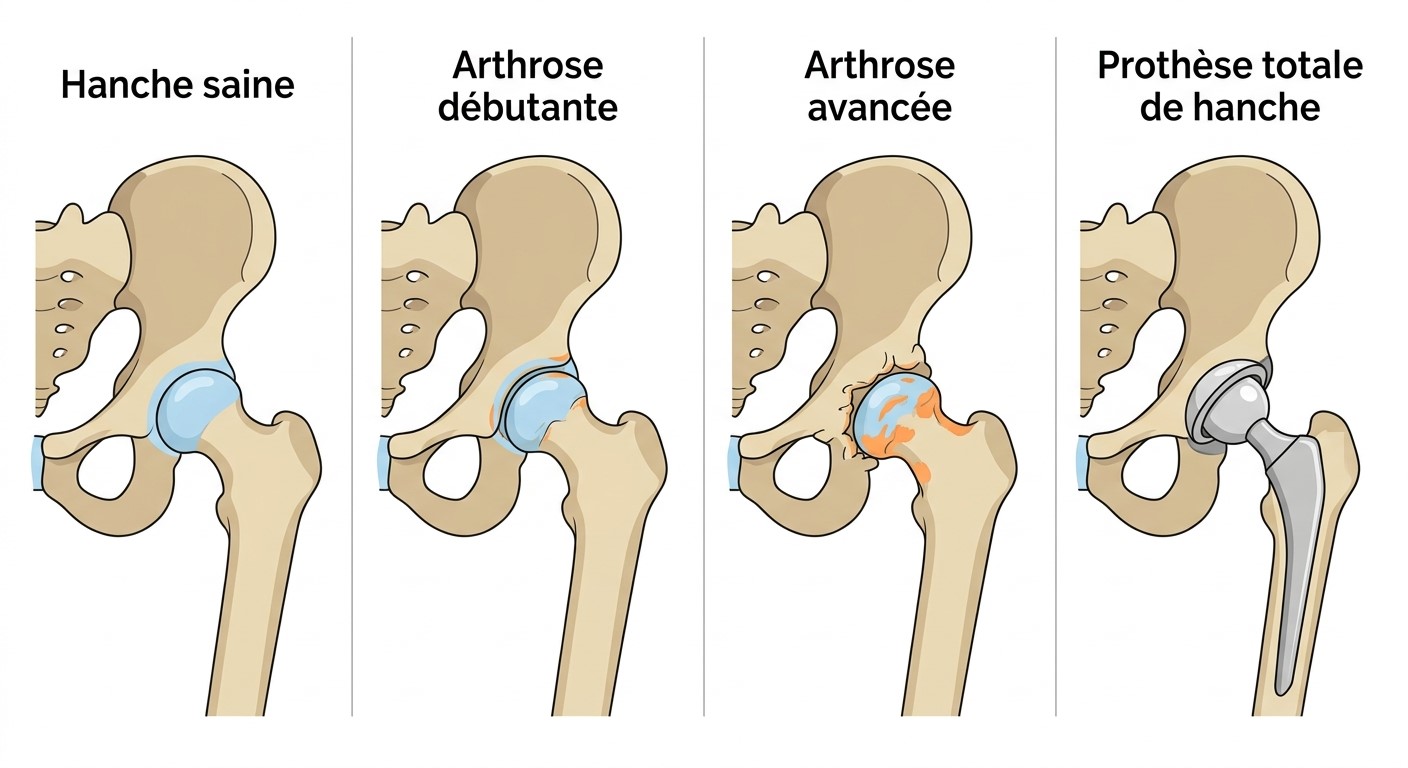
Hip osteoarthritis is the progressive wear of the hip cartilage, causing pain, stiffness and loss of movement. It may be primary (ageing) or secondary to hip dysplasia, femoroacetabular impingement, avascular necrosis of the femoral head, a fracture or inflammatory arthritis.
From early osteoarthritis to total hip replacement (diagram labels in French).
Typical symptoms
Pain in the groin, spreading to the front of the thigh or the buttock
Stiffness in the morning and after sitting for a long time
Limitation: difficulty putting on socks, cutting toenails, getting into a car
A progressive limp
Night pain at advanced stages
A reference operation
More than 180,000 hip replacements are performed in France each year, with a patient satisfaction rate above 95%. It is one of the operations with the greatest impact on quality of life.
When should I consider a hip replacement?
Step 1
Medical treatment
Physiotherapy, painkillers, weight loss, adapted activities, a walking stick when needed, ultrasound-guided steroid injections.
Indication
Advanced osteoarthritis
Disabling daily pain, marked stiffness, advanced changes on X-rays and failure of well-conducted medical treatment.
Other indications
Necrosis, dysplasia, fracture
Avascular necrosis of the femoral head, after-effects of hip dysplasia in young adults, femoral neck fracture in older people, post-infectious arthritis.
Decision
A shared decision
Based on pain, function, imaging, age, other health conditions and your expectations. There is no age limit, but your general health must allow the operation.
Anterior or posterior approach?
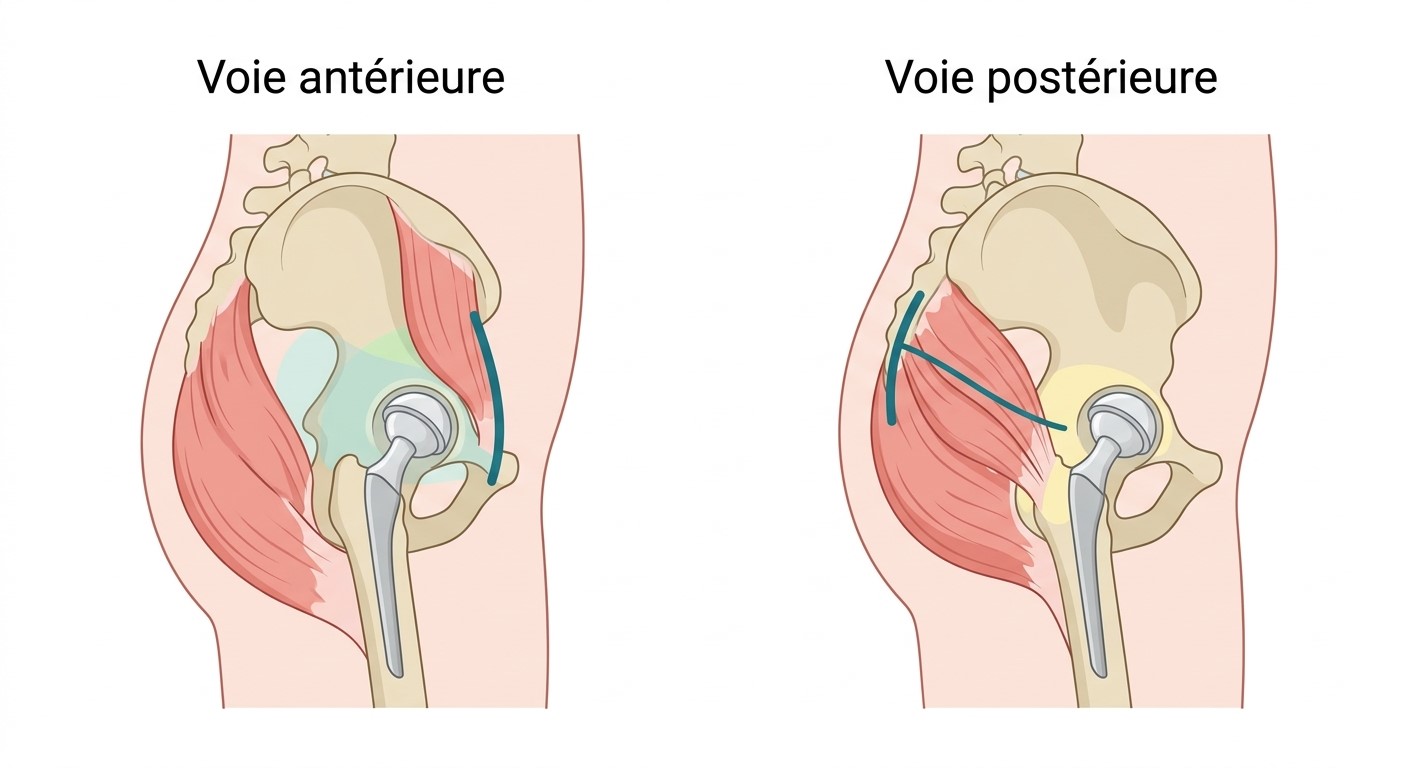
The surgical approach is a major choice. At the Médipôle, the minimally invasive anterior approach is preferred for most patients.
Anterior versus posterior approach for hip replacement (diagram labels in French).
Preferred
Minimally invasive anterior approach
The hip is reached from the front, between the muscles, without cutting them, on a standard operating table with X-ray control. Faster recovery, very low dislocation risk (< 1%), no positional precautions, a more natural gait and a discreet scar. Suitable for most first-time hip replacements.
Classic approach
Posterior approach
The hip is reached from behind, with partial release of the small rotator muscles. A wide, well-proven exposure. Higher dislocation risk (1–3%) and precautions for 6 weeks (high seats, no leg crossing). Used for revisions, major obesity or unusual anatomy.
How is the operation performed?
1
Anaesthesia
Regional or general
Spinal or general anaesthesia depending on your profile, with a nerve block and local infiltration for pain relief.
2
Positioning
Standard operating table
You lie on your back on a standard table; X-ray control is available during surgery to check implant position.
3
Approach
Anterior incision of 8–10 cm
The surgeon passes between the muscles without cutting them to reach the joint.
4
Acetabulum
Preparing the socket
The worn femoral head is removed, the socket is prepared and the artificial cup is impacted, with X-ray control.
5
Femur
Preparing the femur
The stem is inserted (cemented or not, depending on bone quality) and the head is fitted (ceramic-on-ceramic or ceramic-on-polyethylene bearing).
6
Checks
Testing and closure
Stability, movement and leg length are checked before closure. Total duration 1 to 1.5 hours.
What is recovery like?
Hip replacement follows an enhanced recovery programme: preparation before surgery (information, strengthening of the buttock muscles, nutrition, stopping smoking, diabetes control), regional anaesthesia, getting up and walking on the day of surgery, early eating and physiotherapy from day 1.
D0
Day of surgery
First steps
You get up and walk in your room once back from theatre, with a physiotherapist.
D1-3
Hospital
Progressive walking
Walking in the corridor with two crutches, stairs, transfers. Home once you are safe.
W2-3
First step
One crutch
One crutch on the opposite side; walking indoors without a crutch if confident. Exercise bike.
W4-6
Weaning
No more crutches
Normal walking. Driving possible depending on the side. Social activities resume.
M2-3
Active life
Back to activities
Moderate hiking, outdoor cycling, swimming, golf. Return to office work.
M3-6
Sport
Leisure sports
Leisure alpine and cross-country skiing, snowshoeing, doubles tennis, moderate riding.
Physiotherapy is lighter than after a knee replacement: on average 15 to 30 sessions over 6 weeks, focusing on movement, buttock muscle strength, balance and gait.
Which sports can I do with a hip replacement?
Recommended
Walking, hiking, cycling
Excellent for function. Mountain hiking, including large climbs, is possible after 6 months.
Recommended
Swimming, aqua-gym, golf
Gentle sports, ideal after a hip replacement. Golf is possible from 2–3 months (shorter rounds at first).
Possible
Alpine and cross-country skiing
From about 3 months on suitable runs (no demanding off-piste, no racing). Classic cross-country skiing is excellent.
Possible
Doubles tennis, horse riding
Possible with adaptation and a gradual return.
Not advised
Long-distance running, pivoting sports
Trail running, marathons, football, rugby, handball: twisting loads are harmful to the implant in the long term.
Case by case
Off-piste skiing, mountaineering
Discussed individually according to your profile, level and age; not an absolute contra-indication for some motivated patients.
How long does a hip replacement last?
Lifespan depends on your activity, bone quality, the implant and its bearing surfaces. A large review of international joint registries found that about 58% of hip replacements were still in place 25 years after surgery [1], but these were implanted more than 25 years ago. With current implants and bearing surfaces (ceramic-on-ceramic, ceramic-on-highly cross-linked polyethylene), which reduce wear, the life expectancy of a modern hip replacement is estimated at around 30 to 35 years.
What are the risks?
Dislocation (< 1% anterior approach)
The ball comes out of the socket. Very rare with the anterior approach, more frequent with the posterior approach (1–3%), hence posterior precautions for 6 weeks.
Infection (< 1%)
Antibiotics are given during surgery. Any fever with pain in the first 3 months requires urgent review.
Blood clots (< 1%)
Anticoagulants for 4 to 6 weeks, compression stockings, early mobilisation.
Leg length difference
Rare and usually minimal (< 1 cm), well tolerated, corrected with a heel insert if needed. X-ray control during surgery limits this risk.
Fracture around the implant
Rare: during surgery (repaired immediately) or later after a fall; more frequent with osteoporosis.
Long-term loosening
Causes increasing pain, sometimes a limp, and requires a revision (replacement of the implant).
Frequently asked questions
When should I consider a hip replacement?
A total hip replacement is considered for advanced, disabling osteoarthritis of the hip, avascular necrosis of the femoral head, the after-effects of hip dysplasia or a fracture of the femoral neck. The main criteria are daily pain, marked limitation and failure of medical treatment.
Anterior or posterior approach: what is the difference?
The minimally invasive anterior approach passes between the muscles without cutting them, allows a faster recovery and carries a lower risk of dislocation. The posterior approach remains useful in some cases (revision surgery, major obesity, unusual anatomy). The anterior approach is preferred for most patients at the Médipôle.
How long will I stay in hospital?
With the enhanced recovery programme, 1 to 3 days. You get up and walk on the day of surgery and go home once walking is safe and pain is controlled. A longer stay may be needed depending on your situation.
When will I walk again?
You walk with two crutches from the day of surgery, move to one crutch from about 2–3 weeks and usually stop using crutches between 4 and 6 weeks. Walking is normal at around 6 weeks, and daily activities are fully resumed at about 2 months.
Which sports can I do with a hip replacement?
Recommended: walking, hiking, cycling, swimming, golf. Possible: leisure alpine skiing and cross-country skiing from about 3 months, doubles tennis, moderate horse riding. Not advised: long-distance running, pivoting or contact sports, demanding off-piste skiing.
How long does a hip replacement last?
Lifespan depends on activity, bone quality, the implant and its bearing surfaces. A large review of international joint registries found that about 58% of hip replacements were still in place 25 years after surgery, but these were implanted more than 25 years ago. With current implants and bearing surfaces (ceramic-on-ceramic, ceramic-on-highly cross-linked polyethylene), which reduce wear, the life expectancy of a modern hip replacement is estimated at around 30 to 35 years.
What is the risk of dislocation?
Very low with the anterior approach (less than 1%), slightly higher with the posterior approach (1–3%). Precautions (avoiding extreme rotation, using high seats for 6 weeks) are less strict after an anterior approach.
When can I drive and go back to work?
Driving: 4 to 6 weeks depending on the side operated (earlier for a left hip with an automatic car). Office work: 4 to 6 weeks (working from home is possible earlier). Physical work: 3 to 6 months depending on the job.
Sources
Evans JT, Evans JP, Walker RW, Blom AW, Whitehouse MR, Sayers A. How long does a hip replacement last? A systematic review and meta-analysis of case series and national registry reports with more than 15 years of follow-up. Lancet 2019;393(10172):647-654. doi:10.1016/S0140-6736(18)31665-9
Other figures on this page reflect the information given on our French page and Dr Pacoret's practice at the Médipôle de Savoie.
Do you suffer from hip osteoarthritis?
A specialist consultation assesses your hip and discusses the best strategy: medical treatment or a hip replacement through the anterior approach. Appointments with Dr Pacoret can be booked online on Doctolib (available in English).
This page does not replace a medical consultation. In an emergency, call 112 (European emergency number) or 15 (French emergency medical service, SAMU), or go to the emergency department of the Médipôle de Savoie (+33 (0)4 79 26 82 82).